

How To Do Pen And Ink Drawings
Page : ane two 3 4
Cartoon in Pen and Ink : Techniques for Pen Drawing
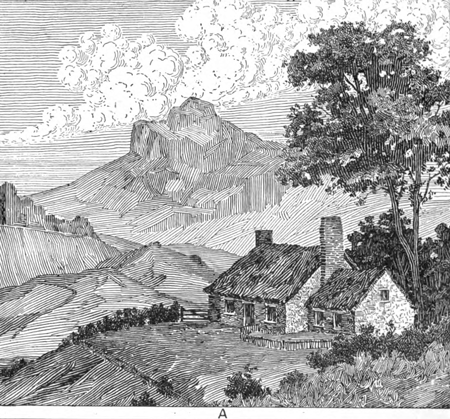
How to vary tone in ink drawings
The technique of the pen is vastly different from that of whatsoever other tool the artists apply, and the work washed with a pen is consequently very unique. By nature it is a much harsher and a less flexible musical instrument than either the pencil or the brush, fifty-fifty though pens take come a long manner. A pen cartoon has a distinct individuality, no matter what kind of a technique is used, fundamentally because of the manner of getting the various tones and shadows, which is different from that in the other mediums generally used.
In pen drawings, the ink goes on to the paper in its total forcefulness, unlike with other mediums. In other mediums, you either add water or white to go lighter tones, still with pen and ink, you use the white of the paper to get lighter tones. To get a half tone, or quarter tone, or whatever tone is desired, the intensity of the color must, of form, be reduced, but this reduction of tone is produced by using the white paper as the reducing medium. Instead of h2o or white being mixed with blackness and then applied to the paper, the solid blackness is put upon the newspaper, which itself is used for the white and mixed with the black as the latter is placed upon it. This is washed by ways of lines, stipples, etc. (which volition be described later on), all of which, in some class or other, permit the white paper to prove through and, past mixing with the ink, produce a reduced tone of black. For a dark or heavier tone, more ink lines are used, for a light tone more newspaper shows through, the ink lines existence thinner or farther apart. If we take a space say ane inch square and colour it solid black, in that location is a black spot one inch each way; if we exit it untouched, and so there is a white i; if we embrace it with black lines that are the same thickness every bit the white ones in between, then nosotros get a one-half tone; if with lines that are three times as wide as the white, it is a three-quarter tone; if the white spaces are three times the width of the ink lines, and so it will be a quarter tone. The ratio of the blackness lines to the white spaces of paper that shows through between is the factor that governs the tone, and, every bit the tones of a drawing vary greatly, the heaviness of the lines and the proportion of the white paper must, of necessity, vary as well.
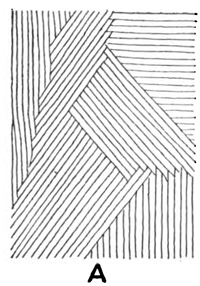
Light Tone
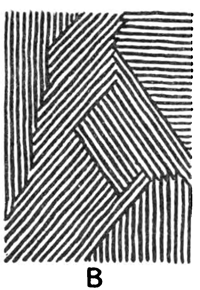
Nighttime Tone
A, for instance, shows a light tone, while in B a dark ane is seen. They are both tints made by lines running in the same direction, and of the same graphic symbol. The difference in tone is obtained by the difference in the thickness of the lines used, and in the size of the white spaces showing between. In A, the black lines are thin and the white lines between thick; while in B, the black lines are much thicker and the white ones thin. In other words, if the corporeality of black on a square of the same size of white paper is more than in B than it is in A, B is necessarily the darker tone. More than ink, a darker tone; less ink, a lighter ane.
Line piece of work
As the most popular and as the fashion in full general apply, lines should be considered first. They fall naturally into two kinds—loose lining and regular lining.

Loose Lining
Loose lining is a fashion wherein the move of the hand and fingers is largely automatic; it is fatigued chop-chop, and with no bully effort made to keep the lines equidistant, though a good artist will instinctively describe them fairly even. Loose lining can be created simply by moving the fingers and manus dorsum and forth over the paper. More pressure on the pen volition, of course, make a heavier line; less pressure, a lighter one. This is the same method as in writing, a heavy pressure spreads the point of the pen and makes a darker line.
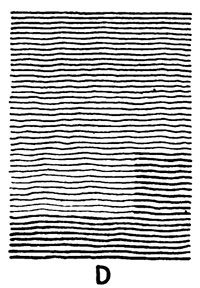
Regular Lining
D shows a foursquare of regular lines, which is drawn in a very dissimilar manner from C. The direction of every line is carefully watched, and the lines are "drawn"; that is, they are directed with precision to keep them the aforementioned distance autonomously and the same depth of color. The lines should be mechanically perfect in direction, thickness, and separation. When a darker tone is required, as at the lesser, make the lines thicker; for a slightly lighter, make them thinner or farther apart. It volition be noticed that there is a slight gradation of tone in the foursquare.
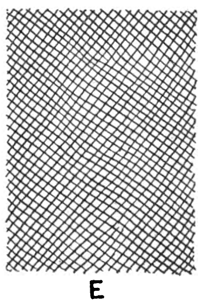
Crosshatching
E shows a square of lines crossed by other lines. This is known as crosshatching, and is sometimes used for the purpose of darkening a tone already laid downwardly. Crosshatching is seldom seen any more, except for certain special uses or to add a piffling variety of technique to a cartoon. For an ordinary tint, it is hardly e'er used, mod exercise enervating that the tint shall be made by placing the lines closer together, or past making them heavier. Sometimes, in the darker parts of a drawing, where the tone needs to be very heavy, yet not black, and the black lines have been made equally wide as is convenient or as will look well, crosshatching may exist practiced. In this case, information technology turns the thin, white lines into pocket-size, white dots, and makes the tone darker.
Page : 1 ii 3 iv

Pages: 1 two 3 4

Source: https://www.drawinghowtodraw.com/stepbystepdrawinglessons/2010/01/drawing-in-pen-and-ink-techniques-for-pen-drawing/
Posted by: galelecought.blogspot.com
0 Response to "How To Do Pen And Ink Drawings"
Post a Comment