

How To Draw George Washington's Face

ii. Face

2. Face
Symbolic: 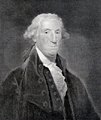 | | Engraving of George Washington past Thomas Holloway later Gilbert Stuart used in Johann C. Lavater's Essays on Physiognomy National Portrait Gallery, Smithsonian Institution |
Stuart, similar many of his contemporaries, believed in physiognomy, the theory that a person'due south advent reflected temperament and character. Thus Stuart wanted to depict Washington so that his sterling grapheme would exist conveyed. An engraving of Stuart's start portrait of Washington was used as an illustration for a book, Essays on Physiognomy. In the book, a writer comments that "every thing in this face announces the good man, a man upright, of simple manners, sincere, firm, reflecting and generous."
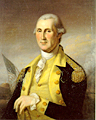 | | George Washington, past James Peale, circa The Warner Collection |
A description of the Lansdowne painting in a London newspaper in 1797 observed that "The countenance is mild and all the same forcible. The center, of a lite grey, is rendered marking by a brow to which physiognomy attaches the sign of ability. The brow is ample, the nose aquiline, the mouth regular and persuasive. The face is distinguishable for musculus rather than flesh, and this may be said of the whole person."
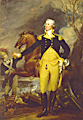 | | George Washington past John Trumbull, Metropolitan Museum |
Contemporaries who gazed upon Washington seemed to see more a human. Descriptions of him bordered on mythical. His caput, said an observer, was "well shaped . . . gracefully poised on a superb neck," with "a large and directly" nose, "blue gray penetrating optics," loftier cheek bones, and a large mouth.
Biographic: 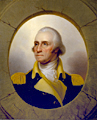 | | George Washington (Porthole portrait) by Rembrandt Peale, oil on sheet, circa 1823-1860 National Portrait Gallery, Smithsonian Establishment. Souvenir of an anonymous donor |
Abigail Adams, wife of John Adams, turned to the poetry of John Dryden to depict Washington: "He's a temple Sacred by birth, and congenital by hands divine." "Sacred, divine"—the words evoked the nation's feelings well-nigh this man. They saw in his stern, nonetheless engaging, face, reflections of inner virtues. Information technology was a German-linguistic communication paper that gave him his lasting championship: Des Landes Vater, the Begetter of His Country.
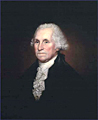 | | George Washington past Rembrandt Peale, oil on sheet, circa 1853 National Portrait Gallery, Smithsonian Institution. Gift of an anonymous donor |
An acquaintance one time noted that Washington was "generally sedate and serious"—and "only after having two or three glasses of wine" plus some spirited conversation "does his face assume an expression of liveliness." Abigail Adams said he "has a nobility which forbids familiarity mixed with an piece of cake affability which creates love and reverence."
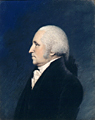 | | George Washington by James Sharples, pastel on newspaper, circa 1795-1796 National Portrait Gallery, Smithsonian Institution |
While many men in America wore wigs before the Revolutionary War, this practice began to go out of style later on 1776. By the fourth dimension Gilbert Stuart painted this portrait in 1796, Washington's addiction of powdering his ain natural hair would have fit the mode of the day. He tied his hair in a queue, which was sometimes worn in a small blackness silk bag.
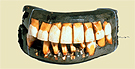 | | Washington'southward dentures, fitted with man teeth and modeled teeth carved from cow teeth and elephant ivory, circa 1790 Mountain Vernon |
His painful, ill-fitting dentures made Washington'southward mouth bulge out; he clamped his lips to hold them in. Supposedly he lost his teeth by cracking Brazil nuts between his jaws. By the time he became President, he had merely i molar left. One ready of dentures was carved from hippopotamus tusk and had a infinite to accommodate the single tooth. This caused nigh abiding pain, which he tried to ease with laudanum.
Artistic: 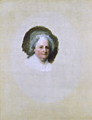 | | 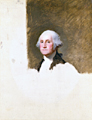 | | George Washington and Martha Washington (Archives portraits) by Gilbert Stuart, oil on sail, 1796 National Portrait Gallery, Smithsonian Establishment, owned jointly with the Museum of Fine |
Afterwards Stuart painted his first portrait of Washington, probably in 1794-95, Martha Washington asked to have her own portrait washed, besides as some other 1 of the President. Intended for Mountain Vernon after Washington'due south retirement, the portraits are known as the Athenaeum portraits because the Boston Archives acquired them after Stuart'due south death. In these portraits, Washington faces left, and Martha faces slightly to the right, so the pair would be balanced.
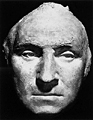 | | 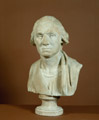 | | Life Mask of George Washington by Jean-Antoine Houdon, plaster, October 1785 The Pierpont Morgan Library, N.Y., U.s.a. George Washington by Jean-Antoine Houdon, plaster bust, circa 1786 National Portrait Gallery, Smithsonian Institution |
Stuart admired the sculpture of Washington past French artist Jean-Antoine Houdon, probably because information technology was based on a life mask and therefore extremely authentic. Stuart explained, "When I painted him, he had just had a ready of faux teeth inserted, which accounts for the constrained expression so noticeable about the rima oris and lower part of the face. Houdon'southward bust does not suffer from this defect. I wanted him as he looked at that fourth dimension." Stuart preferred the Athenaeum pose and, except for the gaze, used the same pose for the Lansdowne painting.
When Stuart began painting a portrait, he used muted tones of lights and darks, an "indistinct mass of light & shadows," showing the subject "as seen in the heel of the evening, in the gray of the morn, or a distance too great to discriminate features with exactness." In completing a portrait, he brash painters to "be bold and use the colour freely, but let information technology be well mixed" with "no fuzzy edges, simply liquid and all of 1 bandage."
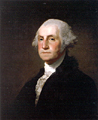 | | George Washington (Athenaeum type) past Gilbert Stuart, oil on canvas, not dated The Corcoran Gallery of Art, Washington, D.C.; William A. Clark Collection |
Some critics claim that Stuart made Washington appear too stern. But the artist always said he painted what he saw: "Nature as Nature cannot exist exceeded, and as your object is to copy Nature, twere the hight of folly to wait at any thing else to produce that copy."

Source: https://georgewashington.si.edu/portrait/face.html
Posted by: galelecought.blogspot.com
0 Response to "How To Draw George Washington's Face"
Post a Comment